Reviving the Victorian Aesthetic: How Billy Money Transforms Modern Design
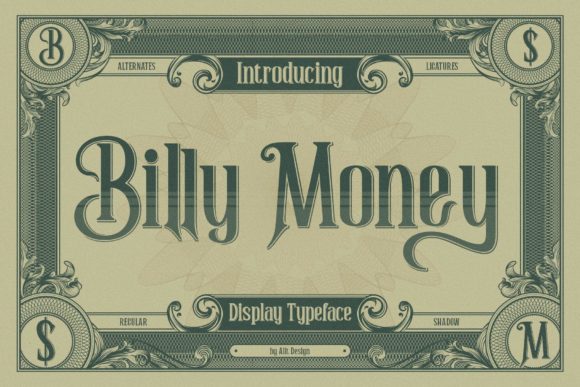
In an era where digital minimalism and sans-serif dominance often dictate the visual landscape, there remains a profound desire for designs that evoke history, authority, and craftsmanship. This is where Billy Money enters the conversation as more than just a typeface; it is a bridge connecting contemporary creators with the ornate elegance of the Victorian banking era. Inspired by the intricate typography found on historical banknotes, this display font captures a specific moment in design history when security, artistry, and legibility were woven together into a single visual language.
The aesthetic of the 19th century was defined by complexity and detail. Banknotes from this period were not merely currency; they were canvases featuring elaborate engravings, fine lines, and serifed text that conveyed trust and permanence. Billy Money distills these elements into a functional tool for modern designers who wish to inject that same sense of gravitas into their projects. Whether applied to a craft label or a digital certificate, the font brings an immediate narrative of heritage and quality.
The Historical Roots of Victorian Typography
To understand the impact of Billy Money, one must first appreciate the context from which it draws its inspiration. During the Victorian era, the printing of banknotes was a high-stakes endeavor. Governments and private banks needed to create currency that was difficult to counterfeit while simultaneously projecting an image of national stability. The solution lay in the use of highly detailed engraving techniques and serif typefaces that mimicked the hand-lettering of scribes.
These fonts were characterized by high contrast between thick and thin strokes, sharp serifs, and intricate ligatures. They were designed to be read clearly even at small sizes, yet they possessed an inherent decorative quality that made them suitable for formal documents. Today, many of these original styles are considered outdated or overly ornate for general body text. However, as a display typeface, Billy Money resurrects these characteristics without the clutter that would hinder readability in modern layouts.
The resurgence of interest in vintage aesthetics has created a unique opportunity for designers to utilize these historical forms. By adopting a font like Billy Money, creators can tap into the subconscious associations viewers have with the Victorian age: reliability, tradition, and luxury. This psychological connection is particularly potent in industries where trust and provenance are paramount.
Applications in Branding and Packaging
The versatility of Billy Money makes it an exceptional choice for branding efforts that aim to stand out through distinctiveness. One of the most prominent applications lies in the world of alcoholic beverage packaging. In a crowded market, spirits, wines, and craft beers often rely on packaging to tell a story of origin and method. Using Billy Money on labels for whiskey, gin, or rum instantly suggests a product that adheres to traditional recipes and aging processes.
Consider the design of a premium bottle of bourbon. The label might feature Billy Money for the brand name, evoking the feel of an old ledger or a historic estate deed. When paired with textured paper stock and foil stamping, the font amplifies the perception of value. It signals to the consumer that this is not a mass-produced commodity but a curated experience rooted in history.
Similarly, the cosmetics industry, specifically within the realm of grooming products like pomades and beard oils, has seen a surge in demand for vintage-inspired packaging. Barbershops and boutique grooming brands frequently use Billy Money to create a cohesive visual identity that resonates with clients seeking classic style. The font's ability to mimic the look of official certificates allows these brands to present their products as "certified" quality items, adding a layer of prestige to the unboxing experience.
- Spirits and Wine Labels: Creating a sense of heritage and authenticity for premium drinks.
- Grooming Products: Enhancing the appeal of pomades and shaving kits with a masculine, classic vibe.
- Luxury Packaging: Adding a touch of opulence to gift boxes and limited edition releases.
Certificates, Awards, and Official Documents
One of the most practical and powerful uses of Billy Money is in the creation of certificates, diplomas, and awards. Historically, important documents were printed using fonts that resembled the engraving found on currency to prevent forgery. While modern technology has largely replaced physical engraving, the visual language of the "official document" remains strong in the public consciousness.
When an organization issues a certificate of completion, a membership award, or a letter of recognition, the typography plays a crucial role in how the recipient perceives the value of the document. A standard sans-serif font may feel too casual or corporate. In contrast, Billy Money provides the necessary weight and formality to make the document feel significant. It transforms a simple piece of paper into a keepsake that the recipient is likely to frame.
Educators and institutions can leverage this font to enhance the perceived prestige of their programs. For instance, a university issuing a special honorary degree or a professional association granting a certification could use Billy Money for the title of the award. The font's intricate details draw the eye and command respect, reinforcing the seriousness of the achievement being recognized.
This application extends beyond paper. Digital certificates used in online courses or professional development platforms can also benefit from the inclusion of Billy Money. By incorporating the font into the header or the seal area of a PDF, designers can maintain the integrity of the document's appearance even in a digital format, ensuring that the visual cues of authority are preserved.
Tattoo Artistry and Personal Expression
The influence of Billy Money extends beyond commercial print into the realm of personal expression, particularly within tattoo culture. Tattoo artists constantly seek fonts that offer both legibility and artistic flair. Traditional American and Old School tattoos often feature bold, blocky lettering, while Neo-Traditional styles embrace more ornate and decorative elements.
Billy Money fits perfectly into the latter category. Its Victorian roots align well with the aesthetic of "old school" tattoos that feature nautical themes, roses, and skulls. The font's high contrast and sharp serifs allow it to hold up well under the stretching and aging process of skin ink. Clients looking for a tattoo that conveys a sense of loyalty, family heritage, or a nod to maritime history will find Billy Money to be an ideal candidate for script work.
Furthermore, the font's ability to mimic the look of banknotes makes it a popular choice for tattoos related to wealth, gambling, or financial independence. A phrase written in Billy Money on a forearm or chest carries a visual weight that suggests importance and permanence. It turns the body into a canvas that tells a story of ambition and tradition, much like the currency that inspired the typeface itself.
Implementation Strategies for Designers
For professionals integrating Billy Money into their workflow, understanding the nuances of its usage is essential to achieving a polished result. Because it is a display typeface, it is not intended for long-form body copy. Instead, it should be used strategically to anchor headlines, titles, and key graphical elements. Pairing Billy Money with a clean, neutral sans-serif font can create a balanced composition where the vintage character of the display font shines without overwhelming the reader.
Color selection is another critical factor. To fully capture the Victorian vibe, designers should consider color palettes that reflect the materials of the past. Deep greens, burgundies, golds, and blacks are excellent choices that complement the font's historical origins. Avoiding neon or overly bright colors helps maintain the illusion of authenticity and prevents the design from appearing dated in a negative way.
- Hierarchy Management: Use Billy Money for primary headings only. Keep secondary text in a simpler font to ensure readability.
- Kerning Adjustments: Display fonts often require manual kerning adjustments. Pay close attention to the spacing between letters, especially in words with ascenders and descenders, to avoid collisions.
- Texture Integration: Combine the font with grainy textures or paper backgrounds to enhance the tactile feel of the design.
- Contextual Relevance: Ensure the font matches the tone of the message. Billy Money is best suited for serious, elegant, or nostalgic contexts rather than playful or futuristic ones.
The Future of Vintage in Digital Spaces
As the digital landscape becomes increasingly saturated with uniform design patterns, the demand for unique, character-rich typography is growing. Billy Money represents a shift away from the homogenization of web design toward a more eclectic approach that values history and storytelling. Educators and researchers studying the evolution of typography will note that the cyclical nature of design trends ensures that Victorian styles will continue to resurface, provided they are adapted for modern constraints.
Business owners looking to differentiate their brands in competitive markets will find that leveraging fonts like Billy Money offers a tangible competitive advantage. It allows a company to position itself as a guardian of tradition in a fast-paced world. Whether designing a barbershop logo, a certificate for a student, or a label for a new line of artisanal coffee, the strategic use of this typeface can elevate a project from ordinary to extraordinary.
The enduring appeal of Billy Money lies in its ability to communicate complex emotions through simple visual means. It speaks of a time when design was an art form deeply intertwined with function and security. By embracing this font, modern creators do not just borrow a style; they adopt a philosophy of craftsmanship that prioritizes detail, intention, and lasting value. As we move forward into new design frontiers, the lessons learned from the Victorian era, encapsulated in fonts like Billy Money, remain as relevant and inspiring as ever.